Muses of the Spheres
Early medieval songs of the Muses and the power of music
Jasmina Črnčič: voice
leiken: voice
Norbert Rodenkirchen: medieval transverse flutes, cithara
Benjamin Bagby: voice, medieval harp
Concept and program design: Norbert Rodenkirchen.
Unless specified otherwise, all transcriptions and reconstructions by Norbert Rodenkirchen.
English translations of the sung texts will be projected during the performance.
Translations of the Notker texts made for Sequentia by Philip Liston-Kraft (Harvard University).
In the program Muses of the Spheres, Sequentia delves into the surprising repertoire of songs composed a thousand years ago in German monastic and cathedral schools. These songs come from a milieu of deep intellectual curiosity, and were often based on texts from late Antiquity, then set to music using creative techniques new to literate musicians. The same intuitive new notation that had been developed earlier for liturgical chant, also sometimes served to document these creations. We find secular songs about the art of music itself (Ars Musica), the magic of musical instruments, the power of music as a science (numbers made audible), and its teaching as an integral part of the Seven Liberal Arts. These are songs by music theory nerds and dreamers, virtuoso musicians who longed to hear the 'music of the spheres'.
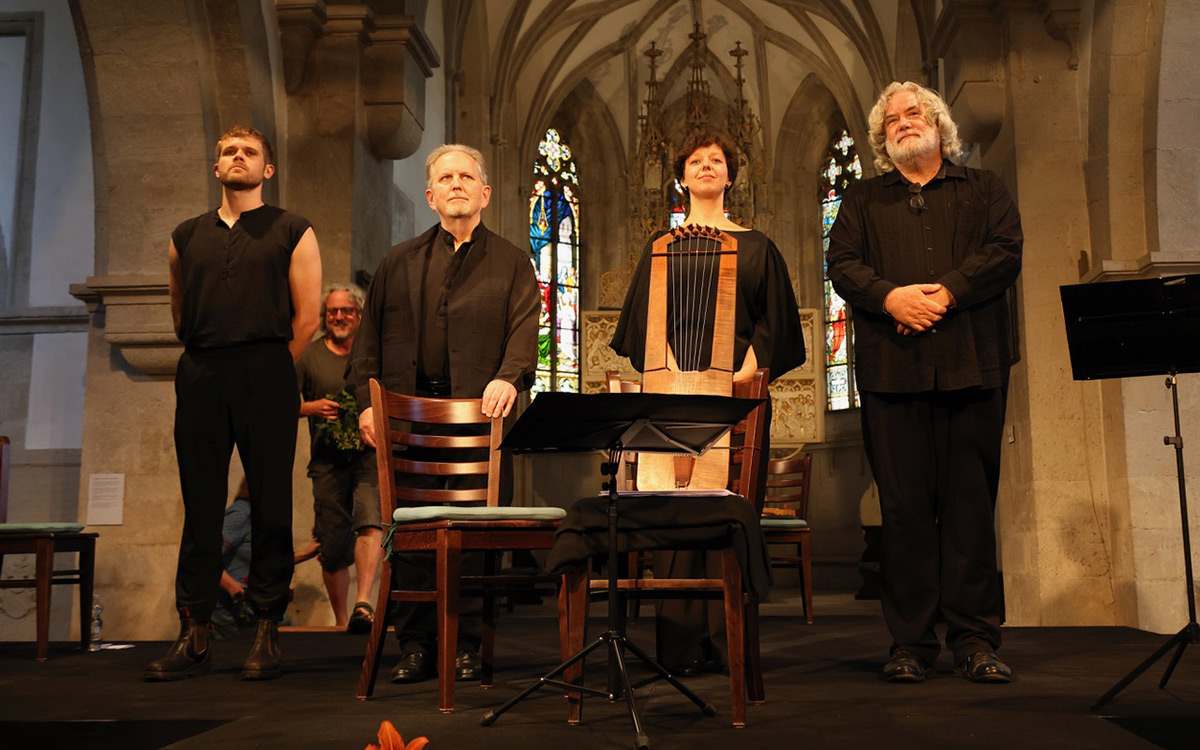
leiken, Benjamin Bagby, Jasmina Črnčič, Norbert Rodenkirchen
This, in turn, is closely related to the Muses, allegorical female figures that originated in Classical mythology and whose imaginal power survived into the Middle Ages and far beyond, largely thanks to an epic allegorical story created in Latin by the 5th century scholar Martianus Capella. In this rambling and zany masterpiece, the god Mercury wants to marry Philology, a mortal girl who is the embodiment of human eloquence and knowledge. Mercury must first ascend into the heavens to seek the blessing of his father, Jupiter. The subsequent wedding party gathers for the ascent to the heavens, with many adventures along the way. They are attended by the beautiful and accomplished muses, and by an amazing wedding gift: the seven liberal arts (studious and disciplined young women, one of whom is Music in person). The wedding is a huge success — and at last report, they are still happily married.
Centuries later, this popular and extravagant tale was re-told and explained in Old High German by the 11th century monk Notker 'Labeo' (the Lip), after which it served as entertaining and educational musical fun for brothers and novices alike, and indeed we find manuscripts from that time containing musical notation, attesting to sung performances. In the 30-year tradition of Sequentia's ongoing 'Lost Songs Project,' and working closely with musicologist Sam Barrett (University of Cambridge) and other scholars, Sequentia presents these 11th-century treasures in compelling new transcriptions and musical reconstructions.
Some of this program's other songs come from 'The Cambridge Songs', an 11th century repertoire of a Rhenish minstrel, singer and harp player whose creations still resonate clearly one thousand years later.
Program
I ta cherubin mysticos
Byzantine Cherubikon from Abbey of Essen Werden (10th century), whose abbess was Sophia, daughter of the Eastern Roman Empress Theophanu.
Wolfenbüttel Nota
Instrumental version of an untitled, textless melody which is notated with neumes, 11th century.
Ter terni sunt modi
A didactic song attributed to the monk Hermannus Contractus, Reichenau, 11th century.
Scande caelo (part I)
Excerpt from the Old High German retelling, by Notker Labeo ('Notker the Lip'), of Martianus Capella's mythological adventure 'The Marriage of Philology with Mercury and the Seven Liberal Arts'. In this first excerpt, Philology is praised with heavenly music by Astronomy and the muse Urania. Reconstruction by Benjamin Bagby, with a Latin refrain set in 2-part organum, newly discovered and transcribed by Sam Barrett.
Salve porta perpetuae lucis fulgida
Instrumental version of a textless melody, Prüm Abbey, 11th century.
Rota modo artes
Pythagorian song from the Cambridge Songs, Rheinland, 11th century. Reconstruction by Benjamin Bagby.
Vatican 'sequela'
Instrumental version of an untitled melody, notated with neumes. Transcription by Sam Barrett.
Scande caelo (part II)
From the Old High German retelling, by Notker Labeo ('Notker the Lip'), of Martianus Capella's mythological adventure 'The Marriage of Philology with Mercury and the Seven Liberal Arts'. In this excerpt, Philology is praised with heavenly music by Geometry and the muses Calliope and Polyhymnia. Reconstruction: Benjamin Bagby, with a Latin refrain set in 2-part organum, newly discovered and transcribed by Sam Barrett
Winchester 'sequela'
Instrumental version of an untitled, textless melody notated with neumes. Winchester Troper, 11th century.
Naturalis concordia vocum cum planetis
Didactic song about musical intervals, 11th century. Transcription by Susan Rankin.
Scande Caelo (part III)
From the Old High German retelling, by Notker Labeo ('Notker the Lip'), of Martianus Capella's mythological adventure 'The Marriage of Philology with Mercury and the Seven Liberal Arts'. In this excerpt, Philology is praised with heavenly music by the muse Melpomene. Reconstruction: Benjamin Bagby, with a Latin refrain set in 2-part organum, newly discovered and transcribed by Sam Barrett
Omnia vincit Amor
Song with neumes based on Virgil's Eclogue X, 11th century.
Rex Caeli
Earliest-known surviving polyphonic music from Musica Enchiriadis, Sequence from Essen Werden Abbey, 9th century. Transcription Jacques Handschin.
O Roma nobilis
Pilgrims' song, 11th century, transcription Benjamin Bagby.