Chant Wars
In co-production with the ensemble Dialogos (Paris)
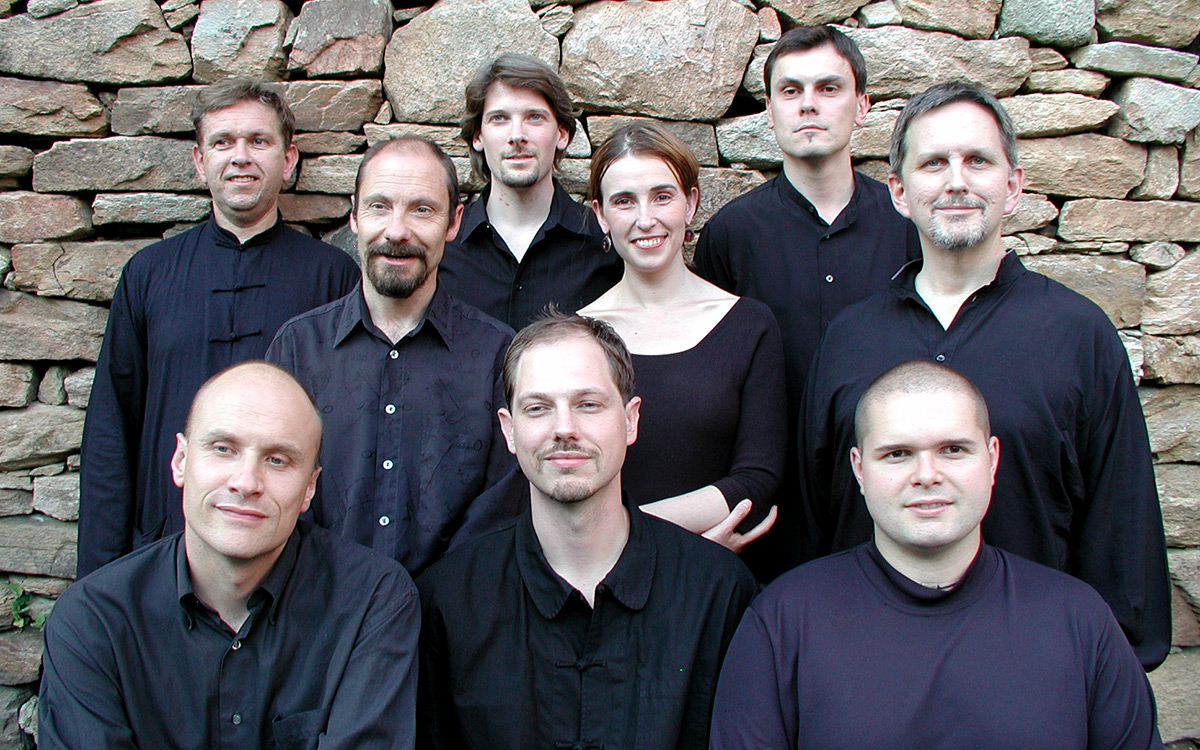
Benjamin Bagby (co-direction): voice, harp
Olivier Germond: voice
Katarina Livljanic (co-direction): voice
Francisco Mañalich: voice
Vincent Pislar: voice
Jean-Paul Rigaud: voice
Wolodymyr Smishkewych: voice
Michael Loughlin Smith: voice
The Carolingian 'Globalisation' of Medieval Plainchant
For centuries, Parisians and visitors to Paris have been thrilled by the imposing Cathedral of Notre Dame, whose massive towers and elegant flying buttresses dominate the Ile de la Cité. We perceive the cathedral as a large church, a single building surrounded by city streets, kitschy souvenir shops, overpriced cafés, a park with romantic benches for lovers, and the long lines of tourists waiting to climb the towers. But in the 12th century, the cathedral of Notre Dame was situated within its own 'campus', a vast complex of interconnected buildings (including several smaller churches) surrounding the cathedral itself, all encircled by a wall and enclosing almost one full third of the island. Within these walls (the 'close' of the cathedral precinct) there existed an autonomous mini-state, with its own laws and enforcement, free from the secular power wielded by the French king residing nearby; with housing and meals for the hundreds of clerics who worked and lived there; with an army of servants to keep the whole place operating smoothly; with students from many countries following lectures in theology and philosophy; with aristocratic churchmen called canons, managing their vast estates and political intrigues from comfortable dwellings within the close.
"Grail" performance: B. Bagby, K. Livljanic, N. Rodenkirchen. Photo © g. Hausmann
Sequentia and Dialogos, two of Europe's most important medieval ensembles, merge their forces for an innovative programme of medieval chant based on the original research of singer and musicologist Katarina Livljanic (director of Dialogos).
The theme of Chant Wars is the legendary 9th-century confrontation between the cantors of the Carolingian emperors and the various regional European chant traditions they sought to replace with their own musical repertoires and vocal styles. Our performances will be interspersed with readings from medieval witnesses to this confrontation (John the Deacon, Notker of St. Gall, Walahfrid Strabo, Paul the Deacon and Charlemagne himself), helping us to illuminate the vocal and performative techniques and the astonishing diversity of chant styles in medieval Europe, at a time when chant traditions were competing for ascendancy in the young empire of Pippin, Charlemagne and their successors.
'Between the stream and its source, where is the purest water to be found?'(from John the Deacon, Life of Gregory)
The Emperor Charlemagne (d. 814) is said to have uttered these words when asked to resolve a dispute between his own Frankish cantors and those of the pope in Rome, each group of vocalists convinced of its own authenticity in singing. Charlemagne, who was acutely aware of the decline of liturgical singing and the many competing chant traditions in his wide-ranging empire, expressed with this phrase his desire to return to the purity of the 'original source', the chant of Rome (but his motives were many-layered: the ideal of Roman authority, expressed in music and the liturgy, would also aid the emperor in the consolidation of his dynasty's legitimacy). This ideal has been voiced by various personalities between the 9th century and our own time, throughout the long history of the liturgical song commonly known as 'Gregorian chant'; used in reference to opposing views of reality, Charlemagne's phrase continues to witness to the fact that disputes about that mysterious ideal – the authenticity of liturgical chant – have never ceased to flourish.
The theme of 'Chant Wars' is the legendary 9th-century confrontation between the cantors of the Carolingian emperors and the various regional European chant traditions they sought to replace with their own musical repertoires and vocal styles. Our performances will be interspersed with readings from medieval witnesses to this confrontation (John the Deacon, Notker of St. Gall, Walahfrid Strabo, Paul the Deacon and Charlemagne himself), helping us to illuminate the vocal and performative techniques and the astonishing diversity of chant styles in medieval Europe, at a time when chant traditions were competing for ascendancy in the young empire of Pippin, Charlemagne and their successors.
Given the fact that we can be guided by only a handful of late written manuscript sources, together with historical witnesses – mostly anecdotal – to performance techniques, how can we understand and bring to vocal life again the many diversities between medieval Rome and Carolingian Gaul?
In this concert, the singers of Sequentia and Dialogos join together to present aspects of these contrasts, these musical and vocal conflicts transmitted to us by singers of the Middle Ages. Surviving texts by such personalities as Paul the Deacon (a southerner) or Notker of St. Gall (a northerner) often refer to the differences between attitudes towards singing liturgical chant. But are these men speaking only of differences between melodies, of the kind that might be visually perceived in the comparative tables of musicological analysis, but which might not necessarily be audible to the listeners who heard them in oral tradition? And what if the word difference signified, to the contemporaries of Charlemagne, something more like a diversity in the manner of execution, or in the approach to the articulation of a text, in the subtle use of vocal resources? Perhaps the difference was perceived in the number of singers who made up the schola cantorum of some foreign land, or even in their 'strange' manner of pronouncing Latin? Listening for the sonorities created by the confrontation between group and soloist, how can we make use of various vocal registers and make use of various pronounciations of Latin according to the regional provenance of the chant being sung? These are questions which must remain forever without unequivocal answers. In our approach to these sometimes virtuosic melodies, we examen all these factors, trying to sense the delicate borderlands between same, similar, and different.
Having been in almost continuous usage in the liturgy, Gregorian plainchant has not always enjoyed the privilege (or should we say the bad luck?) to be considered as 'medieval' music, and thus didn't necessarily have to conform to the ever-changing aesthetic vogues of the recently created world of 'historically informed' performance. As a living music shared today by active religious communities, secular vocalists interested in medieval performance practice, musicologists and liturgists, plainchant continues to arouse opposing approaches to its interpretation. Nowadays, unfortunately, this plurality of interpretive styles is not always accompanied by a tolerance of divergent musical ideas. The participants in today's aesthetic 'chant wars' surrounding Gregorian chant sometimes still harbor a latent belief in 'Romanness', in the supremacy of one singing style over all others, and a desire to be the bearer of the unique 'truth'. In our 'Chant Wars' we attempt to orient ourselves towards the other pole of the problem: by considering the plurality of European chant traditions, we may be able to better understand repertoires which, at the beginning of their existence and for hundreds of years thereafter, were transmitted from singer to singer in oral tradition.
Katarina Livljanic, 2004
The Pieces
Latin chant and medieval German song from a variety of European traditions: Frankish, Germanic, Gallican and Roman.
I. The myth of Gregorian Chant
Gregorius praesul (trope: Prologus antiphonarii)
II. Traces of oral chant traditions from Rome and Gaul
Ad dominum dum tribularer (gradual: Roman 'schola chant')
In convertendo dominus (Roman responsorial psalmody)
Venite populi
Memor sit dominus (Gallican antiphons 'ad communicandum')
Dicamus omnes (Gallican preces)
III. Germanic voices
Was líuto filu in flíze (excerpt from Otfrid von Weissenburg's Evangelienbuch)
Domine, exaudi orationem meam (tractus from St. Gall)
Natus ante saecula (sequence by Notker of St. Gall)
IV. A new Roman chant tradition?
Alleluia: Prosechete laos (Alleluia in Greek)
Saepe expugnaverunt (tractus)
Deus enim firmavit (offertorium)
V. Chant in Frankish books and memories
Laudate Dominum (psalmody 'alleluiaticum')
A solis ortu usque ad occidua (lament on the death of Charlemagne, †814)
Collegerunt pontifices (processional antiphon)
Christus vincit (Laudes regiae: acclamations for the emperor)
The CD of Chant Wars was released in 2004 on the Deutsche Harmonia Mundi label (BMG Classics/SONY).