Le Roman de Fauvel – Concert
Scenes from a clandestine political satire
(early 14th-century Paris)
Musical direction: Benjamin Bagby
Voices: Stef Conner, Jasmina Črnčič, Camille Fritsch, Esther Labourdette, Hanna Marti, Elodie Mourot, Sarah Richards, Tessa Roos
The old king is dead, and the time has come for accounts to be settled. The king's ambitious courtiers, his clueless sons, the faction of his powerful younger brother, his corrupt and unpopular ministers, the high clerics of the Church, and the court intellectuals are all competing for influence, securing their positions, hoping to influence the kingdom's future course.
In this period of instability and fear, a handful of court insiders – young intellectuals working in the royal chancery and chapel – begin to circulate a strange and subversive poem, later accompanied by songs and paintings in a luxurious, clandestine manuscript: a delirious allegorical satire which bitingly comments on events without naming names. It is a scathing vision of a world gone mad, where an animal rules men, men become like beasts, and corruption and vice triumph on all levels; where the kingdom itself is debased and made feeble, where the personified vices are ascendant, where the country risks being overrun with chaos. Who will save the kingdom from this horrible fate?
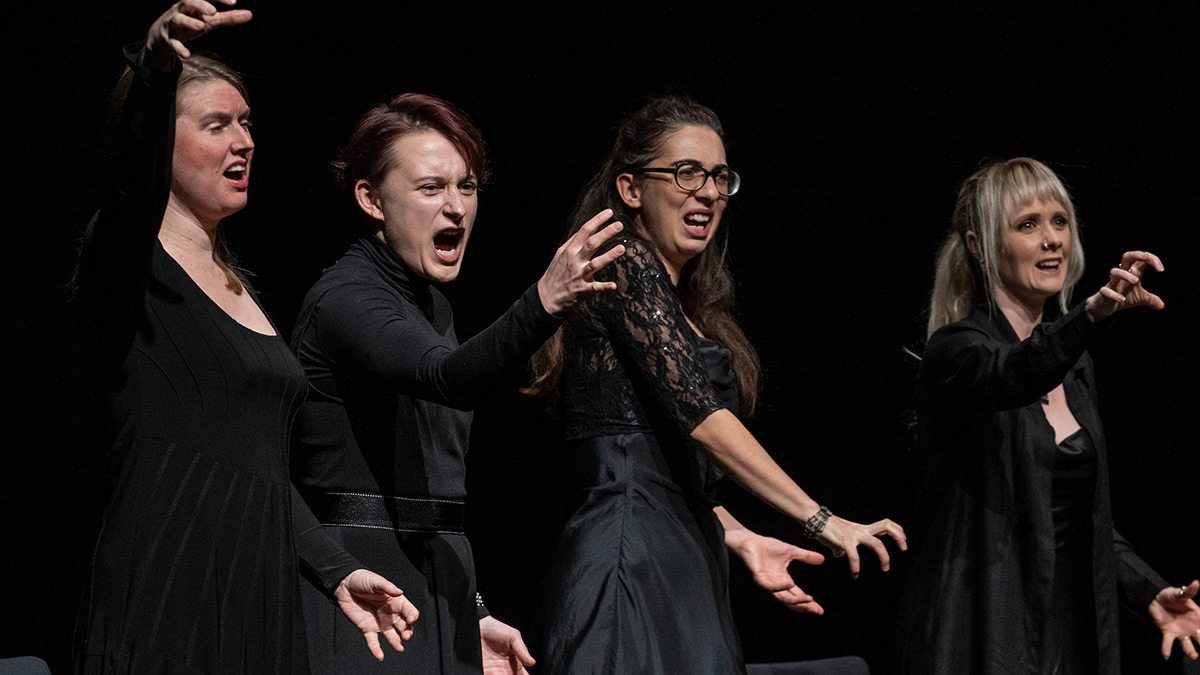
Sarah Richards, Hanna Marti, Esther Labourdette, Stef Conner
The kingdom is France. The time is 1315. The subversive poem is called Le Roman de Fauvel.
Who or what is Fauvel? He is at first just a little fauve-colored horse in a stable in Paris, who manages to ascend to power among the elites. It seems that the innately unstable goddess Fortune, jealous of her irritatingly stable sister, Sapience (Wisdom), has decided to favor Fauvel, moving him into the royal palace, where he is 'curried' (torcher Fauvel) by one and all. The power-hungry beast becomes a beastly man: as his name shows us, he is the personification of the vices: F = Flatérie (flattery), A = Avarice (avarice), U = Vilanie (meanness), V = Varieté (unpredictability), E = Envie (envy), and L = Lascheté (cowardice). His name also means Faus-vel = veil of falseness. He is a fake ruler.
As his power is consolidated and all crave his favour, Fauvel sees that he does not yet have complete control over his fate, and so after consultation with his courtiers (an army of Vices) he resolves to marry, and therefore dominate, the goddess Fortune herself. Although she rejects him with withering sarcasm, there is yet a consolation prize offered as bride: Vaine Gloire (= Vain Glory). The marriage is celebrated,. and a celebratory tournement is held, with the Vices jousting against the victorious Virtues, and the poem ends with a lament, fearing that the offspring of this horrible union will pollute 'le jardin de douce France'.
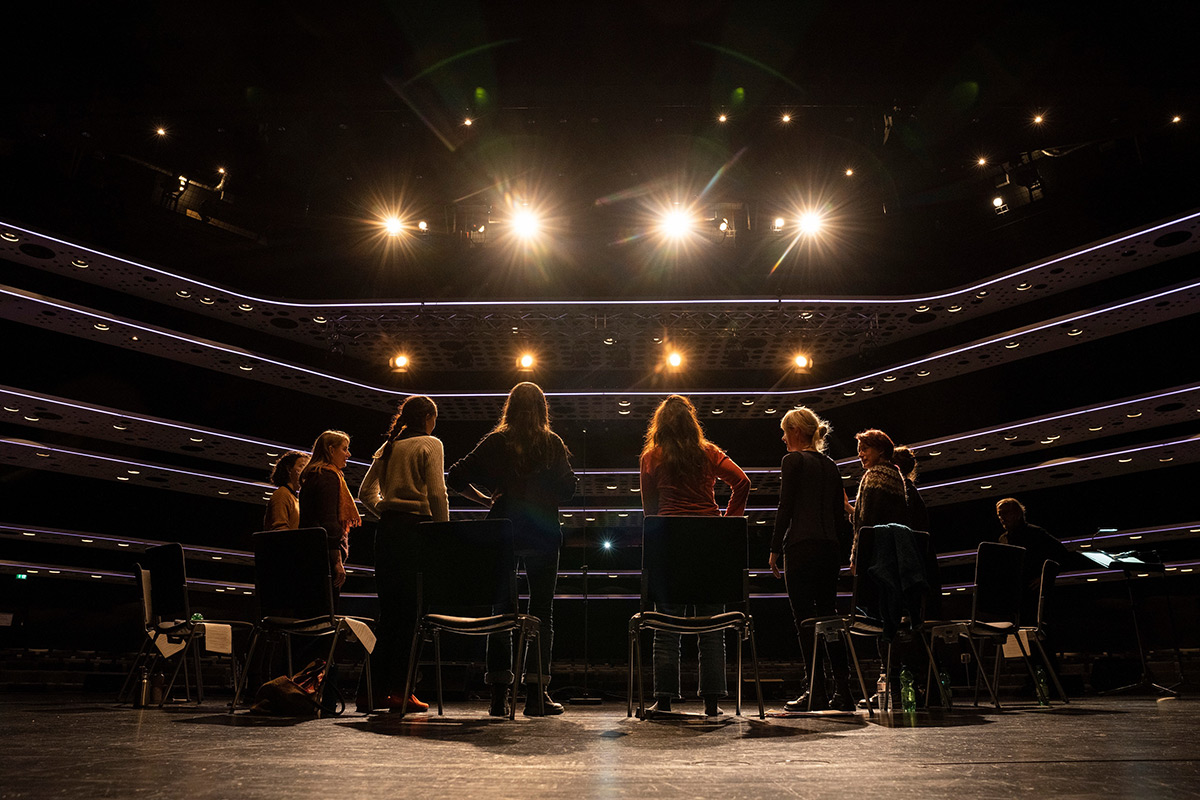
On stage for rehearsal at the concert hall in Herne, Germany
Rondeau: Porchier mieuz estre ameroie (fol. 10r)
A protest song, rejecting the world and values of Fauvel
Motet: Celi domina / Maria virgo / Porchier mieuz estre (fol. 42v)
The same protest song, made into the structural voice of a polyphonic praise-song to the Virgin, asking for her help in defeating the tyranny of Fauvel.
Ballade: Douce dame debonaire (fol. 16v)
Fauvel proposes marriage to the goddess Fortune. She rejects him completely.
Lai: Je, qui poair seule ai (fol. 19r)
Fortune reminds Fauvel of her power and noble lineage, and condemns him. As part of her stinging rebuke, she offers him her lady-servant Vain Glory, a beautiful but nasty young woman, as a marriage substitute.
Lai: Veritas, equitas, largitas corruit (fol. 22r)
A venerable Latin lai by Philip der Kanzler (d. 1236) is re-purposed here, lamenting the total breakdown of society and all goodness, justice and truth in the modern world of lies, falsehood and blind ambition.
Virelai: Providence, la senee (fol. 23v)
Fauvel finally understands his rejection by Fortune and the humiliation of his ambitions.
Lai: Fauvel cogita (fol. 29r)
In another lai by Philippe le Chancelier, re-purposed from one hundred years earlier, Fortune reminds Fauvel that all life is transitory, and that he is doomed to perish along with all his offspring.
Motet: Aman novi / Heu Fortuna / Heu me (fol. 30r)
A 3-voice motet by Philippe de Vitry (1291-1361), in which Fauvel's lament serves as a structural voice, above which two new voices (one of them also Fauvel) sing simultaneously of the treachery of Fortune, the dangers of ambition, citing the Biblical story of Haman's gallows, and the myth of Icarus. The listener in Paris would have known this image referred to one of the king's corrupt ministers who was brought down, hanged for treason after a show trial.
Lai des Hellequines: En de dous temps d'este (fol. 34v)
The wedding of Fauvel and the nasty Vain Glory is celebrated at the corrupt royal court in Paris. Among the many guests who arrive (including all the vices) there is a mythological giant called Hellequin (= Erlkönig) and his retinue of supernatural ladies with aristocratic names, the 'hellequines'. In this lai they sing one of the greatest poetic love-debates of medieval Europe, the Responsorium: Filie Iherusalem, noli timere (fol. 37r)
The wedding celebration includes a tournement, with jousting on horseback, between the Vices (Fauvel's female courtiers) and the Virtutes. This liturgical chant celebrates a vision of angels seen in the sky above Paris, climbing up and down two huge ladders from heaven into the lodgings of the virtues in the city, bringing comfort to them before the conflict. It is now also a battle-cry to give them courage before the tournement.
Responsorium: Sancta et immaculata virginitas [and others]: a selection of chants.
In the manuscript, the tournement is represented in music by a large number of short chant fragments embedded throughout the text. Some of them are real, excerpted from actual liturgy, but many of them are 'fake chant', created especially for this moment, with no liturgical significance. A selection of these short chants is performed here; they are sung simultaneously, evolving through three modes, to invoke the violent chaos of armed conflict between Vices and Virtues.
Motet: Tribum que non abhorruit / Quoniam secta latronum / Merito hec patimur (fol. 42r)
The tournement is finished and Fauvel's Vices have been defeated by the Virtues. There is hope for the future, but we are reminded of the evil nature of corruption and deception. Wounds will be slow to heal. Philippe de Vitry's 3-voice motet, here in a deconstructed performance, embodies the sadness of a world turned upside-down. "All human things are suspended by a thread, and when it suddenly breaks, even those who were strong collapse".
Chant: Hic fons, hic devius ((fol. 42)
It is revealed that there is a fountain of youth, which can rejuvenate Fauvel's minions from horrible old men back into the corruption of youth's vitality. It is terrifying.
Motet: Firmissime fidem teneamus / Adesto sancta trinitas / [tenor] (fol. 43r)
This 3-voice motet by Philippe de Vitry is a prayer to the Holy Trinity for help, begging for a restoration of divine order in the world, before the followers of Fauvel multiply and pollute 'the garden of sweet France'.
Motet: Garrit Gallus / In nova fert / Neuma (fol. 44v)
Postlude: in Philippe de Vitry's most famous isorythmic motet, the mythological allegory is brought full circle, as the blind old lion (the king) allows the fox to eat the lamenting roosters (the cock, a symbol of France). The sheep are in danger, and a dragon is unleashed. Contemporary listeners would have known that the text refers to actual persons who were executed for corruption, but they hoped for more justice to come.
This is a concert performance of the original staged version by Peters Sellars. The world premiere took place in March 2022 at the Théâtre du Châtelet in Paris. Thanks to Peter Sellars and to the Théâtre du Châtelet (Paris) for permission to perform this original-cast concert version of the staged production.
All performances based on the manuscript: Paris, Bibliothèque nationale de France, fonds français 146 (ca. 1317-20). Sequentia's performance materials were created by Jasmina Črnčič (Sequentia) for the monodies, and Anna Zayaruznaya (Yale University) for the motets.
Consultation and coaching on the pronunciation of medieval French and Latin provided by Hélène Biu (Paris, Sorbonne University) and Pascale Bourgain (Paris, École des Chartes).
The background story
By the end of the long reign of the Capetian King Philippe IV 'le Bel' (1285-1314), there was no lack of scandal or trouble in the realm of France: an adultery crisis in the royal family, the persecution (and mass murder) of the Templars, instability and schism within the Church which brought French popes to Avignon, and fnancial crises due to the predatory policies of Philippe's most powerful and hated minister, Enguerran de Marigny. The king's younger brother Charles de Valois, an enemy of Marigny, tried to infuence the king's two sons, Louis X 'le Hutin' (1314-16) and Philippe V 'le Long' (1317-22). There is even a theory that this poem was created as an admonitio for the young princes at the behest of their uncle Charles, that they might not repeat the mistakes of their father. Upon Philippe's death, Marigny was swiftly tried and executed, an event which is even allegorically celebrated in one of the 'new music' pieces found in the manuscript. Another motet mentions that Philippe V is now king. This story emerges from a very real and dangerous political crisis.
The manuscript
The story is part of a long tradition of animal allegories, culminating in the Renart tales of the late 13th century. Le Roman de Fauvel was frst written by a chancery clerk named Gervčs du Bus (book I in 1310, followed by book II in 1314) and survives in several manuscripts, although only as a poem, without musical additions. But it was the revision and expansion, in 1316-18, made by another chancery clerk, mesire Chaillou de Pesstain, which resulted in the single famous illuminated manuscript we still possess today (BNF fr. 146), a large and luxurious book completed in 1318 and containing the original poem of 3,280 French verses, expanded by 1,808 new verses, and the addition of 169 musical items, in both French and Latin, clearly notated, and 77 images depicting the story.
This book is one of the single greatest treasures of France, and in 2018 it celebrates its 700th anniversary. It is a true multimedia Gesamtkunstwerk of its time and a radical synergy of text, sound and image, all combining to tell a story within the confnes of the royal chancery and chapel, the milieu of intellectuals and courtiers who were all trained in the best schools known in Europe. We will never know if it was 'performed' as a staged drama or pageant, but for an educated reader of the time, just the act of turning the pages of this book would have provided an intensive performance experience.
The entire manuscript of Fauvel can be viewed online.
The artwork
The paintings depict Fauvel's rise to power, his being curried by kings, emperors, nobles, churchmen, monks, bishops, and even the pope. We see him presenting his suit to Fortune, the ensuing marriage and charivari, the tournement, and even a fountain of youth for his evil cohort. Some of the artwork has the quality of a satirical sketch, and here we are made to sense a free spirit which reminds us of such irreverent publications as Charlie Hebdo in our time. Subversive political satire has a long history in France.
The music
The manuscript contains 169 musical numbers, a vast selection of all sung genres known at the time, from liturgical chant (also chant parodies) to 'early music' (Parisian church music from the 12th century, no longer in vogue in 1317, but re-purposed for Fauvel), some of the pieces having altered texts which 'fauvelize' them. But there are also new, cutting-edge polyphonic motets (using the latest notational symbols), as well as French songs in the fxed forms of the time: rondeau, virelai, balade, lai and dit. Most of the music is anonymous, but there are also known composers, ranging from contemporary (Philippe de Vitry, 1291-1361, with 5 motets) to Latin songs by such 'ancient masters' as Philippe le Chancelier (ca. 1170-1236), Gaultier de Châtillon (ca. 1135-ca. 1190), and Adam de Saint Victor (ca. 1110-ca.1150). There is no surviving instrumental music, but depictions of vielles and percussion in the charivari scenes.