Le Roman de Fauvel – Staged by Peter Sellars
Introduction
In March 2022, following several long delays due to Covid 19 restrictions, Sequentia was able to present the premiere our long-awaited production of Le Roman de Fauvel, staged by Peter Sellars at the legendary Théâtre du Châtelet in Paris.
Program book (PDF)
This important monument of Capetian art was transformed by Peter Sellars into something new and disturbing, finding resonances with our times and with the challenges we face in our own world, 700 years later. The program book here (click below the image) contains all the sung and spoken texts, in French and English, as well as interviews and essays by experts. There is also a press summary, which features many interviews and discussions. The photos are from a dress rehearsal, and show the large dimensions of the Châtelet stage, as well as the frightening video images of destruction by fire.
Later that year, the exact same group of singers performed a concert version of all the music, with a narration spoken by Benjamin Bagby (see Le Roman de Fauvel, Concert).
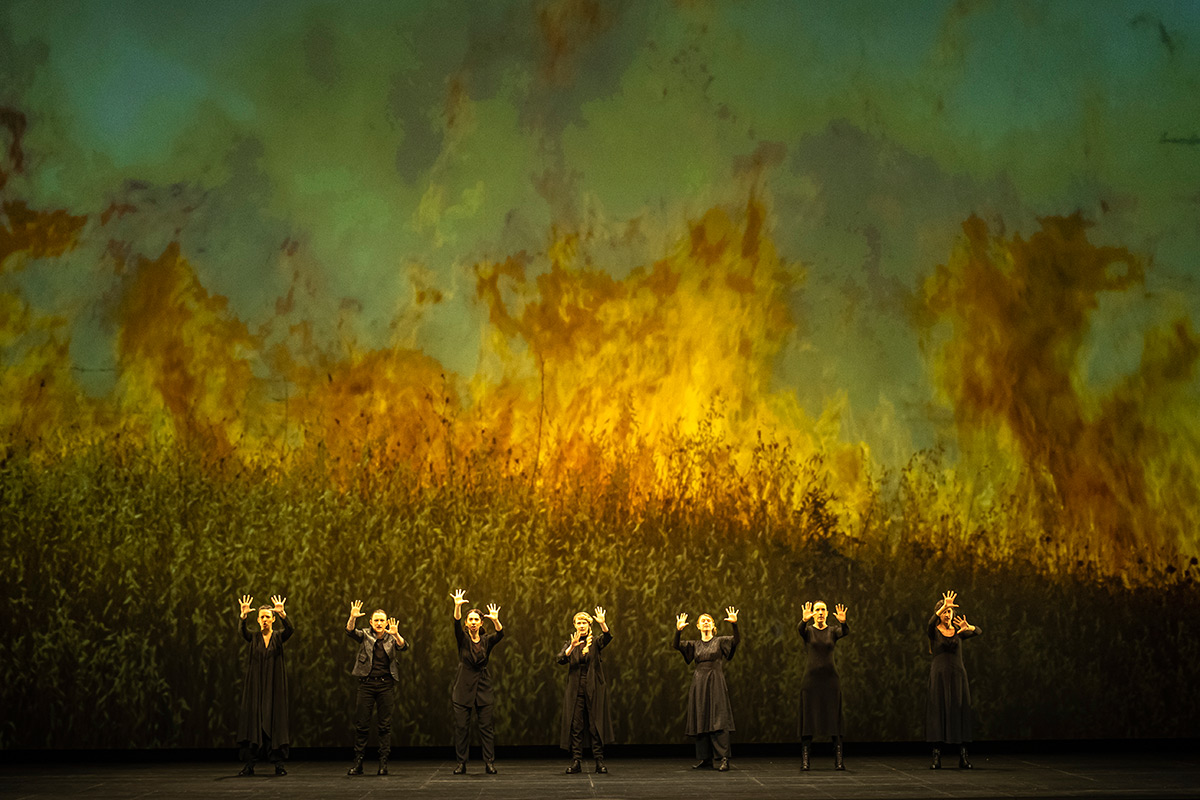
Opening song on the Châtelet stage. Photo: Thomas Amouroux, Théâtre du Châtelet, Paris.
The background story
By the end of the long reign of the Capetian King Philippe IV 'le Bel' (1285-1314), there was no lack of scandal or trouble in the realm of France: an adultery crisis in the royal family, the persecution (and mass murder) of the Templars, instability and schism within the Church which brought French popes to Avignon, and fnancial crises due to the predatory policies of Philippe's most powerful and hated minister, Enguerran de Marigny. The king's younger brother Charles de Valois, an enemy of Marigny, tried to infuence the king's two sons, Louis X 'le Hutin' (1314-16) and Philippe V 'le Long' (1317-22). There is even a theory that this poem was created as an admonitio for the young princes at the behest of their uncle Charles, that they might not repeat the mistakes of their father. Upon Philippe's death, Marigny was swiftly tried and executed, an event which is even allegorically celebrated in one of the 'new music' pieces found in the manuscript. Another motet mentions that Philippe V is now king. This story emerges from a very real and dangerous political crisis.
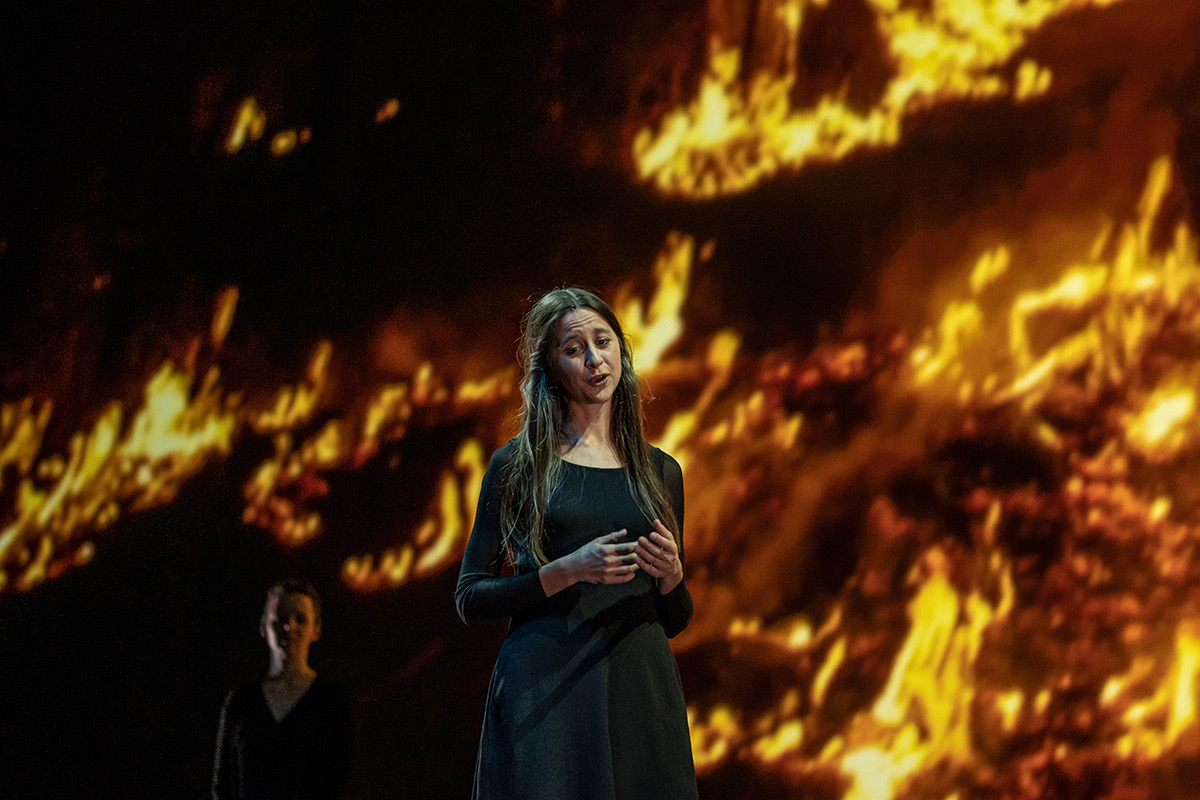
Tessa Roos, as the Blanche Princesse, leads the 'Lai des Hellequines'. Photo: Thomas Amouroux, Théâtre du Châtelet, Paris.
The manuscript
The story is part of a long tradition of animal allegories, culminating in the Renart tales of the late 13th century. Le Roman de Fauvel was frst written by a chancery clerk named Gervčs du Bus (book I in 1310, followed by book II in 1314) and survives in several manuscripts, although only as a poem, without musical additions. But it was the revision and expansion, in 1316-18, made by another chancery clerk, mesire Chaillou de Pesstain, which resulted in the single famous illuminated manuscript we still possess today (BNF fr. 146), a large and luxurious book completed in 1318 and containing the original poem of 3,280 French verses, expanded by 1,808 new verses, and the addition of 169 musical items, in both French and Latin, clearly notated, and 77 images depicting the story.
This book is one of the single greatest treasures of France, and in 2018 it celebrates its 700th anniversary. It is a true multimedia Gesamtkunstwerk of its time and a radical synergy of text, sound and image, all combining to tell a story within the confnes of the royal chancery and chapel, the milieu of intellectuals and courtiers who were all trained in the best schools known in Europe. We will never know if it was 'performed' as a staged drama or pageant, but for an educated reader of the time, just the act of turning the pages of this book would have provided an intensive performance experience.
The entire manuscript of Fauvel can be viewed online.
The artwork
The paintings depict Fauvel's rise to power, his being curried by kings, emperors, nobles, churchmen, monks, bishops, and even the pope. We see him presenting his suit to Fortune, the ensuing marriage and charivari, the tournement, and even a fountain of youth for his evil cohort. Some of the artwork has the quality of a satirical sketch, and here we are made to sense a free spirit which reminds us of such irreverent publications as Charlie Hebdo in our time. Subversive political satire has a long history in France.
The music
The manuscript contains 169 musical numbers, a vast selection of all sung genres known at the time, from liturgical chant (also chant parodies) to 'early music' (Parisian church music from the 12th century, no longer in vogue in 1317, but re-purposed for Fauvel), some of the pieces having altered texts which 'fauvelize' them. But there are also new, cutting-edge polyphonic motets (using the latest notational symbols), as well as French songs in the fxed forms of the time: rondeau, virelai, balade, lai and dit. Most of the music is anonymous, but there are also known composers, ranging from contemporary (Philippe de Vitry, 1291-1361, with 5 motets) to Latin songs by such 'ancient masters' as Philippe le Chancelier (ca. 1170-1236), Gaultier de Châtillon (ca. 1135-ca. 1190), and Adam de Saint Victor (ca. 1110-ca.1150). There is no surviving instrumental music, but depictions of vielles and percussion in the charivari scenes.
Press summary (PDF)